Product Comparison
Byoxon vs. Kantata: Fast PSA Deployment Without Enterprise Consulting Overhead
This article compares Byoxon (BoB) and Kantata, formerly Mavenlink and Kimble, for service firms that need project profitability without a long rollout. It covers what Kantata itself says about implementation time, what each vendor publishes about pricing in September 2026, and where Kantata’s enterprise depth is worth the onboarding effort.

Kantata is one of the most complete professional services automation (PSA) platforms on the market. It formed from the merger of Mavenlink and Kimble, and it serves mid-market and enterprise services firms. Its named customers include Deloitte, Sage and Hitachi. Resource management, project accounting, revenue recognition and a growing set of AI agents all sit in one product.
That depth has a cost in time. Kantata’s own blog says that implementation takes 6 to 8 weeks for mid-size organisations and 3 to 6 months for enterprise-scale, multi-entity rollouts. Kantata also frames this as necessary, because replacing spreadsheets and disconnected tools is not a simple swap. That is an honest position, and for large firms it is often correct.
Byoxon starts from the other end. Its product, BeOnBoard (BoB), is self-serve. You sign up, add people and their rates, log time against a project and read the project profit and loss. There is no implementation project in front of the first margin report. The price is published, and the free plan covers up to five users.
This comparison does not argue that one product is better for everyone. It helps you decide whether your firm needs Kantata’s depth enough to pay for the rollout, or needs a margin number this month.
Byoxon vs Kantata at a glance
| Capability | BoB (Byoxon) | Kantata |
|---|---|---|
| Pricing model | Published per-user rate card | Quote-based, tailored by company size, goals and ways of working |
| Entry price | $24.95/user/month (1–10 users) | Not published |
| Volume tiers | $21.95 (11–49), $18.95 (50–199), $15.95 (200+) | Not published |
| Free plan | Up to 5 users, no feature limitations | None published |
| How you start | Self-serve sign-up | Onboarding services: implementation, technical, adoption readiness, transformation |
| Rollout time | No implementation project required to start | 6–8 weeks mid-size, 3–6 months enterprise (Kantata’s figures) |
| Target size | Small and mid-sized service teams | Mid-to-large firms; Kantata cites 50+ billable resources |
| Time and expenses | Timer, timesheets, kiosk, expense tracking | Timer, timesheets, expenses, approvals, budget limits |
| Resource management | Capacity and staffing views | Deep resourcing, forecasting and AI-assisted team matching |
| Project P&L | Included on every tier, real time | Included, with project accounting |
| Invoicing | Client and contractor billing | Batch invoicing, templates, approval workflows, PO tracking |
| Revenue recognition | Not marketed as a module | ASC 606 / IFRS support as a finance sub-ledger |
| CRM / deal pipeline | Built-in, with deal tracking | Integrates with Salesforce; Kantata SX runs natively on Salesforce |
| HR, PTO, recruitment | Included | Not a core module |
| Integrations | Core modules in one database | 1,200+ prebuilt connectors, APIs and MCP support |
Figures come from each vendor’s own website in September 2026. Kantata publishes no price list, so every Kantata cost figure comes from a sales quote. Confirm current terms before you buy.
Where Kantata is the better choice
Read this part first. For some firms, Kantata is simply the correct purchase, and Byoxon does not compete for that work.
- Multi-entity, multi-currency operations. Kantata says it was built for the multi-entity, multi-currency and complex-resourcing problems that justify a full-suite PSA. If you run several legal entities across currencies, that design matters.
- Formal revenue recognition. Kantata supports ASC 606 and IFRS revenue recognition and connects to finance systems as a sub-ledger. Byoxon does not market an equivalent module.
- Resourcing at scale. Kantata’s resource management, forecasting and AI agents, including the Expertise Agent it launched in June 2026, target firms that staff hundreds of people across many engagements. That is a harder problem than a 30-person agency has.
- Salesforce-centred firms. Kantata SX runs natively on Salesforce. If your sales and finance teams already live in Salesforce, that edition keeps PSA data in the same platform.
- A broad integration estate. Kantata lists more than 1,200 prebuilt connectors, plus APIs and MCP support. Its NetSuite integration alone includes 14 pre-built scenarios for projects, time, expenses and vendor bills.
If those five points describe your firm, the 6-to-8-week rollout buys you real capability. Buy Kantata and plan the rollout properly.
Fast deployment without enterprise consulting overhead
Here is the angle in one sentence. Both products end with a project margin report. The difference is how much work sits between signing and that first report, and who does the work.

What a Kantata rollout involves
Kantata sells onboarding as a set of services. Its services page lists four of them:
- Implementation services to design, configure, test and deploy the processes your firm needs.
- Technical services to integrate other business systems, migrate data and tailor reporting.
- Adoption readiness to prepare for production use and audit adoption.
- Transformation services to add processes after go-live.
This is a serious, well-run programme, and Kantata reports good outcomes from it. It cites one customer, Basware, that completed an end-to-end rollout in under two months with no billing disruption. But the programme is still a project. It needs an owner on your side, decisions about workflow design, and time from the people who will use the system.
Kantata is also direct that the platform’s depth brings a learning curve, and independent review sites repeat that point. For a firm with 300 consultants, the curve is a fair price. For a firm with 25, it can cost more than the problem it solves.
What starting on Byoxon involves
BeOnBoard ships a fixed data model for service delivery. A person record already holds a cost rate and a bill rate. A time entry already points at a person and a project. Because those links exist on day one, the project P&L resolves as soon as the first hours arrive. Nobody has to design the workflow first.
The CRM, invoicing, expenses and HR records sit in the same database. A won deal becomes a project. Hours on the project become an invoice. The invoice, the labour cost and the expenses become the margin. You do not configure these links, because they are the product.
The trade is plain. You give up Kantata’s configurability and its enterprise finance depth. In return, you skip the implementation programme. The project cost management page shows the same data from the delivery side if you want to see the report shape first.
Skip the implementation project. See a project margin this week.
Start free with up to 5 users — no feature limits. Add your people and rates, log a week of time on one real project, and read its P&L. Prefer a walkthrough first? Request a demo and we will show the margin view on your kind of project.
Pricing compared
Kantata publishes no rate card. Its pricing page says plans are tailored by company size, goals and the way your team works, and a PSA Advisor builds the quote. Onboarding services are scoped separately with the vendor. Third-party sites publish per-user estimates, but they disagree with each other, and none of them is a Kantata figure. We do not repeat them here.
Byoxon publishes one volume rate card. BeOnBoard costs $24.95 per user per month for one to ten users, $21.95 for eleven to forty-nine, $18.95 for fifty to one hundred and ninety-nine, and $15.95 for two hundred and above. Every tier includes the full feature set. A free plan covers up to five users with no feature limitations.
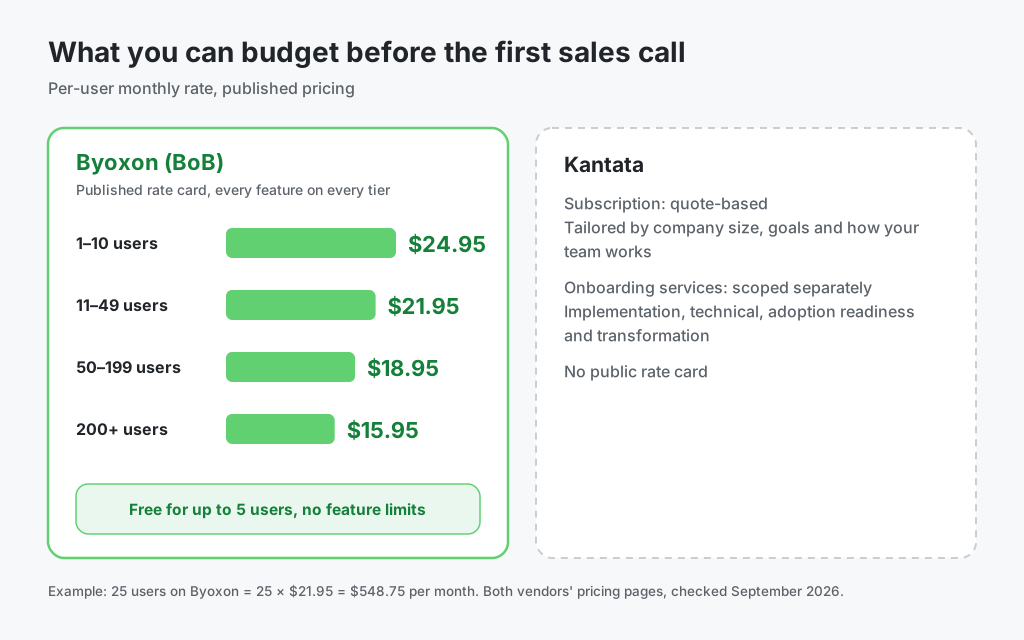
So a 25-person team can budget Byoxon from the website: 25 users at $21.95 is $548.75 per month. The same team cannot budget Kantata until the quote arrives. That does not mean Kantata is more expensive for your team. It means you cannot know before the sales process, and you must add the onboarding scope to the licence.
To check what your own team’s hours cost before you talk to either vendor, use the free time tracking calculator.
Where the depth differs
Both products cover the core PSA chain: time, expenses, projects, invoicing and project profitability. The differences sit at the two ends of that chain.
At the finance end, Kantata goes further
Kantata supports formal revenue recognition, multi-currency account financials, batch invoicing with approval workflows and purchase-order tracking, and deep integration with NetSuite, QuickBooks, Xero and Sage. It acts as a sub-ledger for the finance system. If your controller needs ASC 606 schedules out of the PSA, Kantata is built for that and Byoxon is not.
At the front end, Byoxon includes more in one subscription
Kantata does not market a native CRM. It connects to Salesforce, and Kantata SX runs inside Salesforce. That works well if you already pay for Salesforce. If you do not, the pipeline is a second licence. Byoxon includes a CRM with deal tracking, plus HR records, PTO requests, recruitment and vendor management, at the same per-user rate. For a small firm, that removes two or three other subscriptions and the integrations between them.
Which one fits your team

Choose Kantata if you have more than 50 billable people, several legal entities or currencies, formal revenue recognition needs, or a Salesforce-centred sales team. In that case the rollout is an investment, and the depth pays it back.
Choose Byoxon if you run one entity with one delivery model, if nobody on the team can own a multi-week implementation, and if you want the pipeline, the timesheet, the invoice and the margin in one subscription with a published price.
If you sit between the two, evaluate both honestly. For other points on the same spectrum, read Byoxon vs NetSuite OpenAir and Byoxon vs Certinia, which cover two other enterprise PSA platforms.
Frequently asked questions
How much does Kantata cost in 2026?
Kantata does not publish prices. Its pricing page says each plan is tailored to company size, goals and ways of working, and a PSA Advisor prepares the quote. Onboarding services are scoped separately. Byoxon publishes its rates: $24.95 per user per month for 1–10 users, down to $15.95 for 200 or more, with a free plan for up to 5 users.
How long does a Kantata implementation take?
Kantata’s own blog gives 6 to 8 weeks for mid-size organisations and 3 to 6 months for enterprise-scale, multi-entity rollouts. It cites one customer that finished in under two months. Byoxon is self-serve: you sign up, add people and rates, and log time, with no implementation project before the first project P&L.
Is Kantata the same as Mavenlink?
Yes. Kantata is the company and platform that formed from Mavenlink and Kimble. The standalone platform is Kantata OX, and Kantata SX is the edition that runs natively on Salesforce. Many buyers still search for it as Mavenlink.
Does Kantata include a CRM?
Kantata does not market a native CRM. It integrates with Salesforce, and Kantata SX runs on the Salesforce platform. Byoxon includes a CRM with deal tracking in the same subscription as its time, invoicing and profit and loss modules.
When is Kantata a better choice than Byoxon?
Kantata is the better choice for firms with more than 50 billable people, several legal entities or currencies, ASC 606 revenue recognition needs, or a Salesforce-centred sales team. Byoxon fits smaller single-entity service teams that want project margins quickly without an implementation programme.
The bottom line
Kantata is an excellent enterprise PSA. For large, multi-entity firms, its 6-to-8-week rollout is time well spent, and its finance depth is hard to match.
Byoxon answers a narrower question: what is the margin on this project, right now, without an implementation programme to find out. People, rates, time, invoices and the pipeline are already related to each other, at a price you can read on the website.
Start free with up to 5 users — no feature limits. Load one live project into BeOnBoard this week and compare its margin with the figure you have today.