Product Comparison
Byoxon vs. Certinia: An Independent PSA Platform vs. a Salesforce-Native Suite
This article compares Byoxon (BoB) and Certinia (formerly FinancialForce) for professional services teams evaluating project-financials software. It covers current pricing for both platforms, including Certinia’s requirement for a separately licensed Salesforce org underneath it, and shows which model fits teams that want project profitability tools without also standing up and administering a CRM platform.
Certinia, known as FinancialForce until its rebrand on May 3, 2023, is a professional services automation and ERP suite built natively on the Salesforce platform. It serves some of the largest professional services organizations in the world, and its depth on revenue recognition, multi-entity financial consolidation, and resource management is real.
Byoxon takes a different starting point. Its product, BeOnBoard (BoB), is a self-contained platform — time tracking, CRM, HR, and real-time project P&L in one subscription, with no separate platform to license, configure, or administer underneath it.
This comparison covers pricing, platform requirements, and scope. The goal is to help you decide which model fits your business, not to argue that one tool is universally better.
Byoxon vs Certinia at a glance
| Capability | BoB (Byoxon) | Certinia |
|---|---|---|
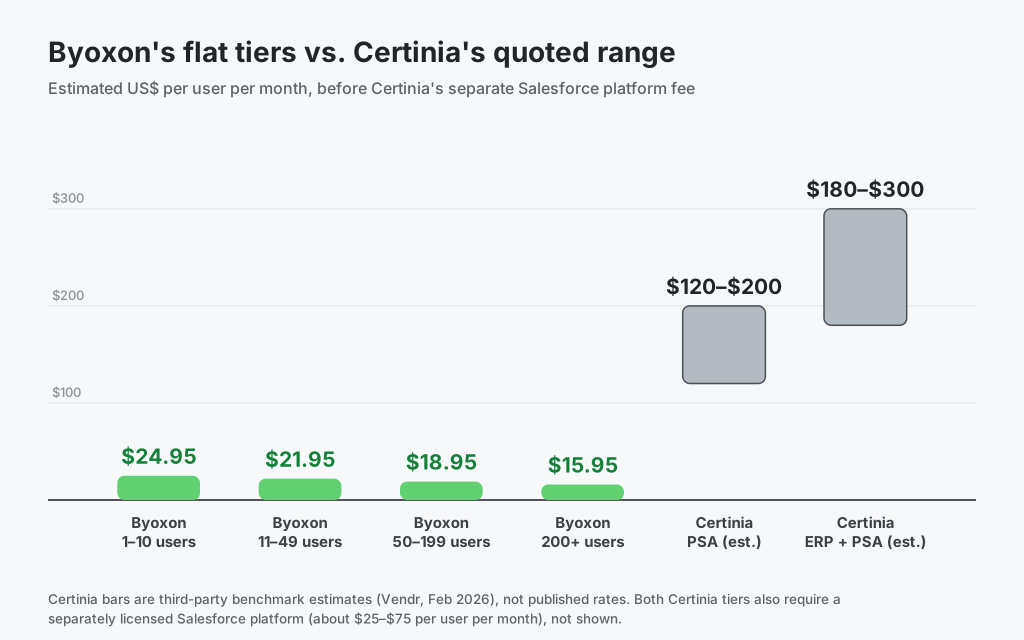
| Entry price | $24.95/user/month (1–10 users) | Not published — third-party benchmarks report PSA licenses commonly $120–$200/user/month for mid-market deployments |
| Highest published tier | $15.95/user/month (200+ users) | Not published — ERP+PSA bundles commonly benchmarked at $180–$300/user/month |
| Underlying platform required | None — self-contained | Salesforce platform, licensed and billed separately (~$25–$75/user/month, per Vendr benchmark data) |
| Free plan | Up to 5 users, no feature limitations | None — enterprise sales-quote model |
| Time tracking | Manual entry and automated timers | Manual and timer entry within the Salesforce UI |
| Invoicing & billing | Included | Included — automated billing with ASC 606 / IFRS 15 revenue recognition |
| Profitability reporting | Included — real-time P&L and unit economics | Included — project and financial analytics across PS Cloud and FM Cloud |
| Resource management | Included | Included — AI-assisted staffing via Veda AI |
| CRM / sales pipeline | Built-in CRM with pipeline stages | Not part of PS Cloud itself; runs on the Salesforce object model, typically alongside a separately licensed Salesforce CRM |
| HR, PTO, recruitment | Employee profiles, PTO requests, recruitment, vendor management | Not included — a PSA/ERP suite, not an HR system |
| Typical implementation | Self-serve signup, live same day | Vendor-led; often 3–9 months, at 50–150% of year-1 subscription cost |
| Best fit | Teams that want margin visibility without standing up a separate CRM platform | Enterprises already standardized on Salesforce that need deep PSA, ERP, and customer-success unification |
Pricing above reflects each vendor’s published rates and third-party benchmarking data (Vendr, February 2026) as of September 2026. Certinia does not publish list prices — verify current figures directly with Certinia before you buy.
Where Certinia is the better choice
Be direct about this first. Certinia wins on several dimensions, and pretending otherwise would not help you decide.
- Certinia goes deeper on enterprise financials. Its Financial Management Cloud handles multi-entity consolidation, complex revenue recognition under ASC 606 and IFRS 15, and general-ledger functions that a lighter PSA platform does not attempt.
- It’s a natural fit if you already run Salesforce. Organizations with an established Salesforce org, admin team, and AppExchange integrations get to reuse that investment instead of standing up a second system of record.
- It scales to large, complex services organizations running many concurrent engagements, multiple legal entities, and layered approval workflows — scenarios where Certinia’s configurability pays for itself.
- Veda AI adds resource-matching intelligence for staffing large consulting benches against many concurrent projects.
If your organization is already committed to Salesforce and needs enterprise-grade financial consolidation alongside PSA, Certinia is a legitimate, mature choice. Choose Byoxon only if the sections below describe problems you actually have.
An independent platform vs a Salesforce-native suite
Certinia doesn’t run standalone. Its own site describes the product as built on the Salesforce platform, using “the same customer records, user experience, and robust analytics” as Salesforce itself. That is a deliberate architectural choice, and it comes with a real cost structure attached to it.
What “built on Salesforce” means for your bill
Every Certinia user is also a Salesforce user. Third-party pricing benchmarks put the underlying Salesforce platform license at roughly $25 to $75 per user per month, billed separately from Certinia’s own subscription. That’s before Certinia’s own PSA or ERP license, which independent benchmarks report at $120 to $300-plus per user per month depending on the bundle. Add implementation — typically 50% to 150% of year-one subscription fees over a 3-to-9-month rollout — and the total first-year cost climbs well beyond the sticker rate on either product.

What running standalone changes
Byoxon does not sit on top of another platform. Time tracking, CRM, HR, and financial analytics all live in one subscription, at one published rate, with no separate object model to license and no additional admin team to staff. A ten-person team can sign up and be tracking real project P&L the same day, without a Salesforce sandbox, a systems integrator, or a rollout measured in months.
This isn’t a knock on Certinia’s architecture — building on Salesforce is exactly why it can offer the enterprise depth described above. It’s a tradeoff: platform leverage and configurability on one side, a single self-contained bill and a same-day start on the other.
See your own project margin, with no Salesforce org to provision first
Start free with up to 5 users — no feature limits. Run one live project through BeOnBoard and see the P&L view the same day you sign up. Prefer a walkthrough first? Request a demo and we will show you how it compares to a Salesforce-native rollout.
Pricing: the sticker rate isn’t the total
Certinia does not publish list prices. The closest independent visibility comes from procurement benchmarking firm Vendr, which analyzed 177 actual Certinia purchases as of February 2026 and found a median annual contract value of $74,402, with individual deals ranging from $4,424 to $304,949.
For a 50-to-100-user deployment on a 12-month term, that same benchmark data reports year-one costs of roughly $250,000 to $600,000 for ERP alone, or $400,000 to $900,000 for combined ERP+PSA, before implementation-cost negotiation — which the same data shows commonly reduces initial quotes by 15% to 30%. Those figures include the separate Salesforce platform fee, since Certinia cannot run without it.
A 75-person team on Byoxon’s volume pricing (the 50–199 tier, at $18.95/user/month) pays $17,055 per year, with implementation limited to onboarding your own team on your own timeline. Run the comparison at your own headcount before deciding. Certinia’s architecture buys deep enterprise capability; Byoxon’s buys simplicity and a predictable, self-contained bill.
Which tool fits your team
Choose Certinia if
- Your organization already runs Salesforce and has the admin capacity to maintain it
- You need multi-entity financial consolidation and complex revenue recognition alongside PSA
- You’re staffing a large bench of consultants across many concurrent engagements
- A multi-month, vendor-led implementation fits your rollout timeline
Choose Byoxon if
- You want project margin visible during delivery, without standing up a separate CRM platform
- You need CRM, time tracking, HR, and financial analytics in one subscription
- Predictable per-user billing, with no separate platform fee, matters more than deep Salesforce-native configurability
- You want to be live and tracking real project data within days, not months
If you are still mapping enterprise PSA options, our Byoxon vs Kantata comparison covers another platform built for large services organizations, and our Byoxon vs Harvest review looks at the lighter end of the market. You can also model your own numbers with the free time tracking calculator.
Frequently asked questions
Is Certinia the same company as FinancialForce?
Yes. FinancialForce.com Inc. was renamed Certinia on May 3, 2023. The products and their Salesforce-native architecture carried over; only the company and product branding changed.
Does using Certinia require buying a separate Salesforce license?
Yes. Certinia is built natively on the Salesforce platform, and every Certinia user must also hold a Salesforce license. Third-party benchmarks report this platform fee at roughly $25 to $75 per user per month, billed separately from Certinia’s own subscription. Byoxon has no equivalent underlying-platform fee.
Is Byoxon a direct replacement for Certinia?
For teams that don’t need Certinia’s deep multi-entity financial consolidation, Byoxon can replace the PSA and CRM functions in one self-contained subscription. Large enterprises with complex revenue recognition needs across multiple legal entities may still be better served by Certinia’s or another dedicated ERP’s depth.
How much does Certinia cost per user?
Certinia does not publish per-user pricing; it sells on a custom quote. Per Vendr’s February 2026 benchmark of 177 actual purchases, PSA licenses commonly run $120 to $200 per user per month and ERP+PSA bundles $180 to $300-plus, for mid-market deployments of 50 to 150 users on 12-month terms — before the separate Salesforce platform fee and implementation costs.
Can I try Byoxon before paying?
Yes. Byoxon offers a free plan for up to five users with no feature limitations, so you can evaluate real-time P&L reporting and CRM on live projects before committing, with no Salesforce org to provision first.
The bottom line
Certinia is a mature, enterprise-grade suite for organizations already standardized on Salesforce that need deep PSA, ERP, and customer-success capability in one connected system. If that describes you, it’s a strong, defensible choice.
Byoxon is built for a narrower, more common question: can we see project margin during delivery, without buying and administering a whole platform to get there? It answers that in one subscription, with no Salesforce org required underneath it.
Run your own numbers on both, including the platform and implementation costs Certinia’s sticker rate doesn’t show. If your team doesn’t already have a Salesforce org to build on, that gap is what Byoxon is for.
Start free with up to 5 users — no feature limits and no platform to provision first. Run one live project through Byoxon and compare the margin figure against what your current stack tells you.