Product Comparison
Byoxon vs Clockify: Free Tracking vs Operational Clarity
This article compares Byoxon (BoB) and Clockify side by side, explaining the gap between a free time-tracking tool and an operational platform built for service teams. It walks through the core features of both systems and shows when teams typically outgrow standalone time logs and start looking for a Clockify alternative that connects CRM, delivery, billing, and profitability.

- Clockify is a lightweight time-tracking tool built to log hours across clients and projects.
- Byoxon (BoB) is an operations platform that connects CRM, delivery, billing, and profitability in one workflow.
Clockify is one of the most popular time-tracking tools in the world. It’s free, simple to adopt, and widely used by freelancers and teams that need reliable time logs without heavy setup. For many service businesses, Clockify is the first step away from spreadsheets.
It’s also where many teams eventually hit a ceiling. Once you need time to connect to pipeline, staffing, delivery, utilization, and billing logic, a pure time tracker starts to feel like only one piece of the operating picture.
That’s the point when teams begin searching for a Clockify alternative—not because time tracking stopped working, but because the business has outgrown what time tracking can handle on its own.
Byoxon (BoB) is built for the next stage, when time tracking is no longer the main process. It connects CRM, delivery, staffing, invoicing, and Profit & Loss reporting into a single operational workflow, so teams can see how work turns into revenue and where margins are gained or lost.
What Clockify does well
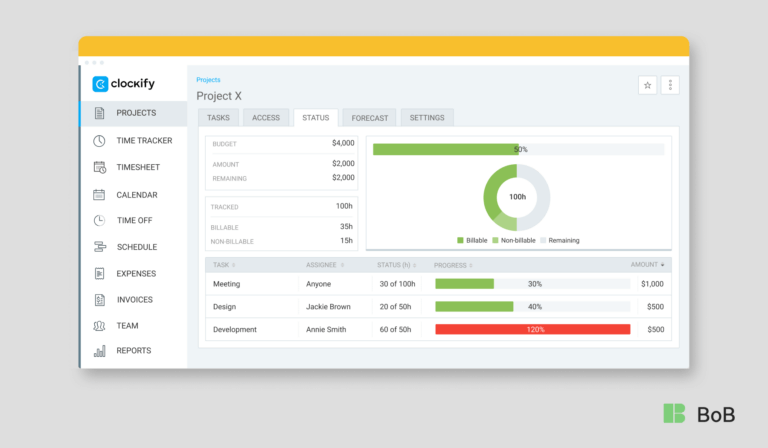
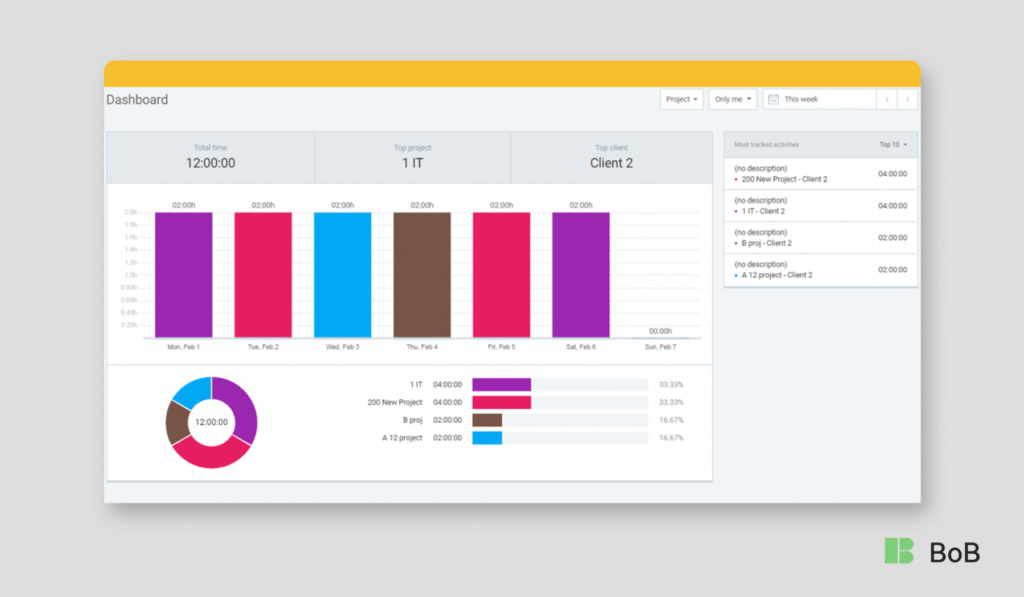
Clockify makes it easy to log hours across clients and projects. Teams can track billable and non-billable time, organize work with projects and tasks, and generate reports that help with reviews, payroll preparation, or client billing. For small teams, this is often enough to replace manual timesheets and reduce the “where did the week go?” problem.
Clockify is also straightforward operationally: it’s quick to roll out, the workflow is familiar, and the value is immediate. If your main requirement is accurate time entries—captured through timers or manual logs—and basic reporting, Clockify fits that narrow scope well. It’s a pragmatic choice when you want fast adoption and minimal process change.
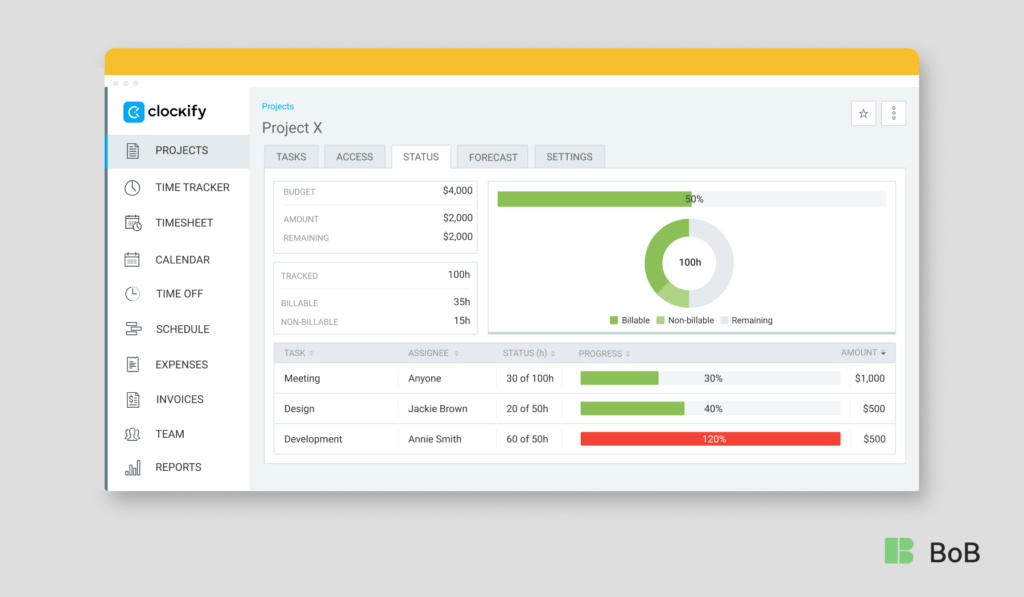
Where Clockify breaks down for service teams
Clockify tracks time, but it does not manage the business around it. The moment your day-to-day work depends on sales handoffs, SOW scope changes, staffing shifts, and multi-rate billing, time entries become “raw material” that needs context.
In practice, that context tends to live outside the system. CRM sits in a separate tool. Delivery planning lives in project boards. Staffing and utilization live in spreadsheets. Invoicing lives in accounting tools.
As complexity increases, the team exports reports, reconciles numbers across systems, and rebuilds operational reality manually: which projects are over-consuming hours, where margins are drifting, which resources are underutilized, and what should be billed next.
That’s the real limitation of free time tracking at scale. It’s not that Clockify can’t show hours; it’s that hours alone don’t answer the operational questions service businesses must answer weekly.
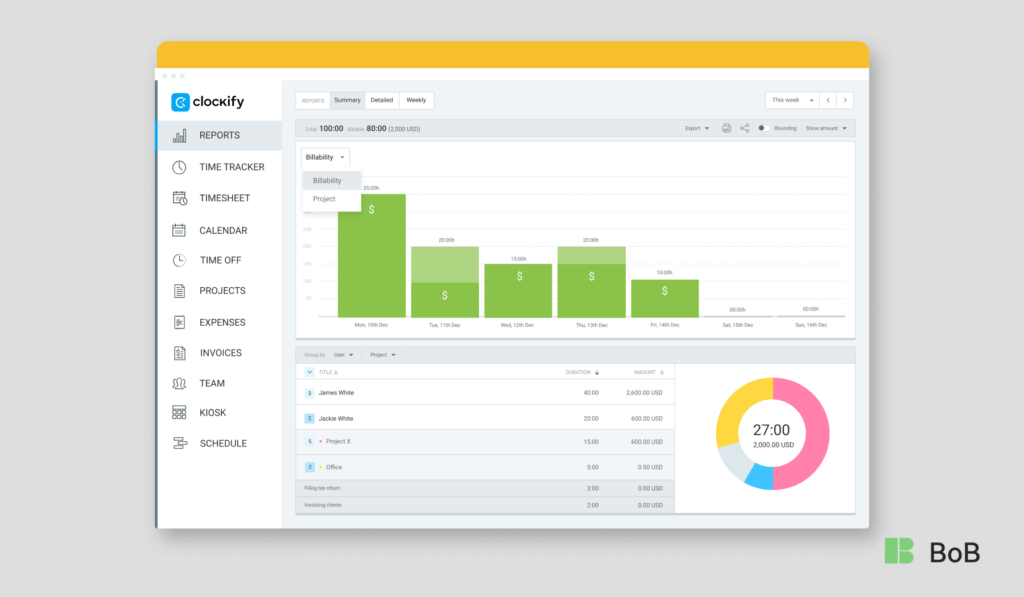
How Byoxon goes further
Byoxon (BoB) is designed for teams that outgrow time tracking and want operational clarity in one system. The key difference is that time, revenue, and delivery are tied together instead of being managed across separate tools.
- CRM that continues after the deal: pipeline doesn’t end at “closed-won”—it turns into a delivery and billing workflow.
- Delivery and staffing tied to revenue: staffing decisions are made with project value and scope in view.
- Utilization and margin visibility in real time: time is interpreted through rates, categories, and project economics, not just logged.
- One system instead of five tools: fewer exports, fewer reconciliations, fewer blind spots.
For teams that need an app like Clockify with CRM, the operational value is the continuity: a single chain from lead → deal → scope → delivery → invoice, with utilization and profitability signals available without spreadsheet reconstruction.
| Feature / capability | BoB (Byoxon) | Clockify |
|---|---|---|
| Primary focus | Service business operations across CRM → delivery → billing → profitability | Time tracking + timesheets + reporting (strong free tier) |
| Free tier orientation | Operational platform (typically adopted for ops + finance workflows) | “Free forever” with unlimited users/projects positioned as a core value |
| Time tracking | Yes (tied to business reporting and billing logic) | Timer + manual entries + timesheets |
| Timesheets workflow | Daily activity logs, approvals/reporting (as described in your BoB copy) | Timesheets with reminders, audit trail, approvals (plan-dependent) |
| Clients & projects | Clients + projects managed alongside CRM context | Clients/projects/tasks/tags to structure tracked time |
| CRM / sales pipeline | Built-in CRM with pipeline stages and deal tracking (core positioning) | Not a CRM (integrates with tools, but doesn’t provide CRM lifecycle) |
| Website lead capture | Custom web contact forms feeding leads into CRM records (HubSpot-like flow) | Timesheets with reminders, audit trail, and approvals (plan-dependent) |
| Delivery + staffing + utilization | Delivery and utilization visibility as part of the operational workflow | Planning/scheduling and utilization are available via Scheduling/Planning features (paid tiers) |
| Invoicing / billing | Automated invoices (custom templates, rates, categories, contractor billing) | Invoicing + recurring invoices are available on paid plans |
| Expenses | Time & expenses used across the team (per your BoB scenario) | Expenses are a paid-plan feature |
| Profitability / P&L | Profit & Loss reports + profitability diagrams (core positioning) | “Labor cost & profit” exists as a paid-plan capability, but not positioned as an end-to-end ops layer |
| Forecasting | Business profitability scenario modeling (as described for BoB) | Forecasting is a paid-plan feature |
| Integrations | (As positioned) reduces reliance on multiple disconnected tools | 80–100+ integrations via extensions; broad ecosystem + Zapier |
| Best fit | Teams that want one system connecting sales, delivery, billing, and profitability | Individuals/small teams that primarily need time tracking and reporting, especially if budget-sensitive. |
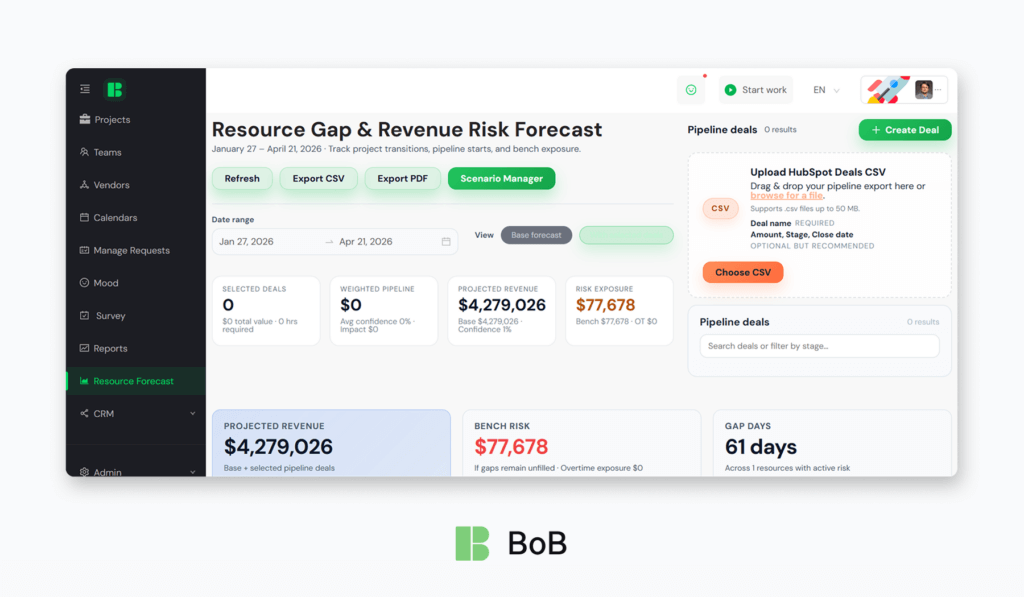
Use case: small team running on Clockify
A 6–10 person web studio uses Clockify to track hours across a handful of clients. Time is logged per project and task, then exported at the end of the month so a manager can assemble invoices in a separate tool. This workflow is clean and predictable as long as the business stays simple—hourly billing, limited role changes, and minimal need for forecasting—so Clockify works well without creating overhead.
The limitations start showing up when the same team begins offering retainers, bringing in subcontractors with different rates, or trying to understand profitability by project rather than just hours worked. Deals and client context live elsewhere, so the manager ends up reconciling time exports with pipeline notes, scope changes, and billing rules across multiple tools. At that point, the team isn’t missing time data—they’re missing the operational connection between time, delivery decisions, and revenue outcomes, which is often why teams start looking for a Clockify alternative.
Use case: distributed service team running on BoB
A 12–18 person service team works across several countries and uses built-in CRM to track leads, client details, deal stages, and ongoing communication in one place. When a deal closes, the same record continues into delivery: staffing is assigned, time is tracked by category and rate, and invoices are generated automatically using custom, auto-filled templates that match local billing standards.
Managers monitor utilization and margins through Profit & Loss reports and profitability diagrams, including temporary subcontractors who enter time and expenses for the projects they support—this is the type of setup where teams look for an app like Clockify with CRM because they need time tracking connected to sales, delivery, and billing.
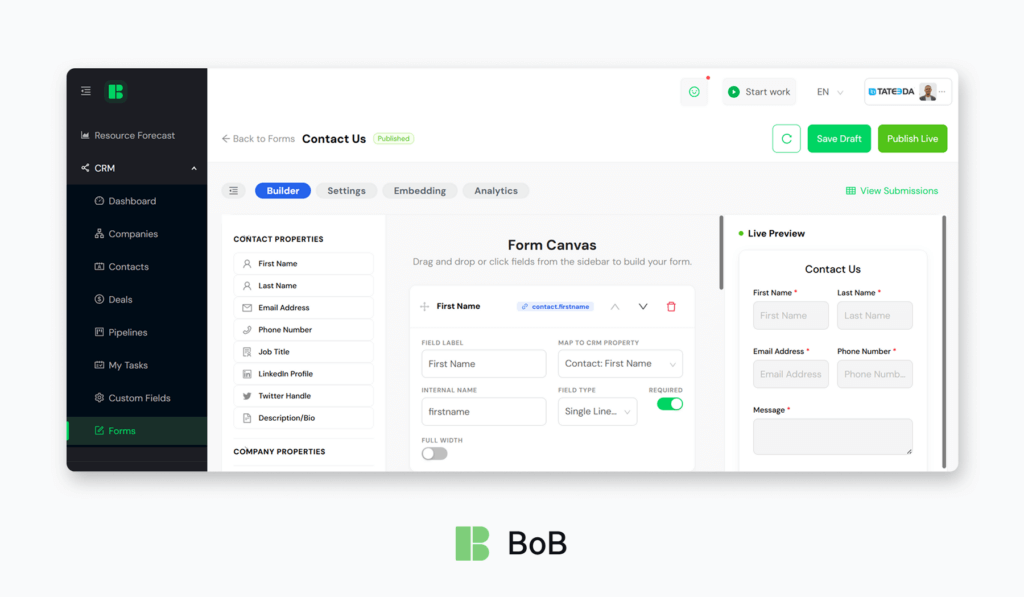
The decision
Clockify tells you how long work took. Byoxon tells you whether that work was profitable—and why.
Choose Clockify when you mainly need clean time logs and basic reporting. Consider Byoxon when time is directly tied to delivery decisions, margin control, and predictable billing. At that stage, teams aren’t just looking for “more features.” They’re looking for an app better than Clockify in the only way that matters operationally: it reduces the gap between tracked work and business outcomes.







![Byoxon vs Kantata: Enterprise PSA vs Modern Service Ops [Kantata Alternative Review]](https://byoxon.com/wp-content/uploads/2026/02/BoB-2-4-768x448.png)