Product Comparison
Byoxon vs Kantata: Enterprise PSA vs Modern Service Ops [Kantata Alternative Review]
This article compares Byoxon and Kantata (formerly Mavenlink), showing the practical difference between enterprise PSA depth and a faster, lighter service-ops approach. It’s worth reading if you’re evaluating a Kantata alternative and want to understand the tradeoffs around onboarding, workflow complexity, and operational control across delivery, billing, and margins.

- Kantata (formerly Mavenlink) is a powerful Professional Services Automation (PSA) platform that positions itself around integrated delivery, resourcing, and financials.
- Byoxon (BoB) is built for modern service businesses that value speed, clarity, and operational control across CRM, delivery, billing, and profitability.
The difference matters because many teams do not fail due to “missing features.” They lose money in the gaps between tools: sales context living in one place, delivery reality in another, and financial truth in spreadsheets.
That’s why this comparison often shows up when teams are evaluating a Mavenlink replacement or considering a lighter Kantata alternative that still supports real service operations.
What Kantata does well
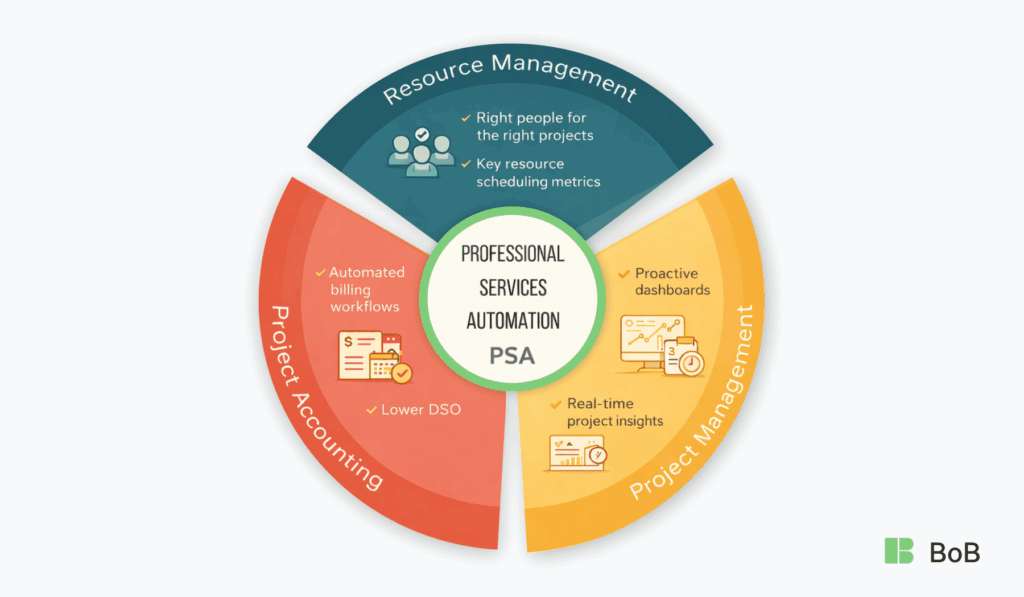
Kantata is strong when you need a broad, end-to-end PSA layer that connects project execution to resource planning and financial reporting. Kantata explicitly positions PSA as an integrated stack covering project management, resource planning, time tracking, billing, and reporting.
In practice, that typically means mature capabilities around enterprise delivery governance: standardized workflows, cross-project reporting, and resource allocation visibility that can scale beyond a single team. Public product positioning and marketplace descriptions also frame Kantata for mid-size to enterprise orgs, not just small teams.
If you are running a services organization where utilization, forecasting, and multi-project oversight are core management activities, Kantata’s depth can be a real advantage.
Where Kantata struggles for mid-sized service teams
That power comes with tradeoffs, especially for teams that want speed and flexibility more than enterprise-grade process. Kantata provides formal onboarding services with experts working through target operating models and tailored configuration, which is valuable, but also a signal that implementation can be a project on its own.
Common friction points show up in review summaries: learning curve, complex usability, and “not intuitive” patterns appear repeatedly in aggregated feedback.
Cost predictability can also be harder upfront because pricing is typically quote-based and tailored, which often correlates with a higher total cost of ownership once you account for onboarding and ongoing administration.
For many PSA for agencies scenarios, the core issue is not whether Kantata can do the job. It’s whether the organization wants the enterprise gravity that comes with it: longer rollout, stricter process, and more internal ownership needed to keep the system tuned.
How Byoxon approaches service ops
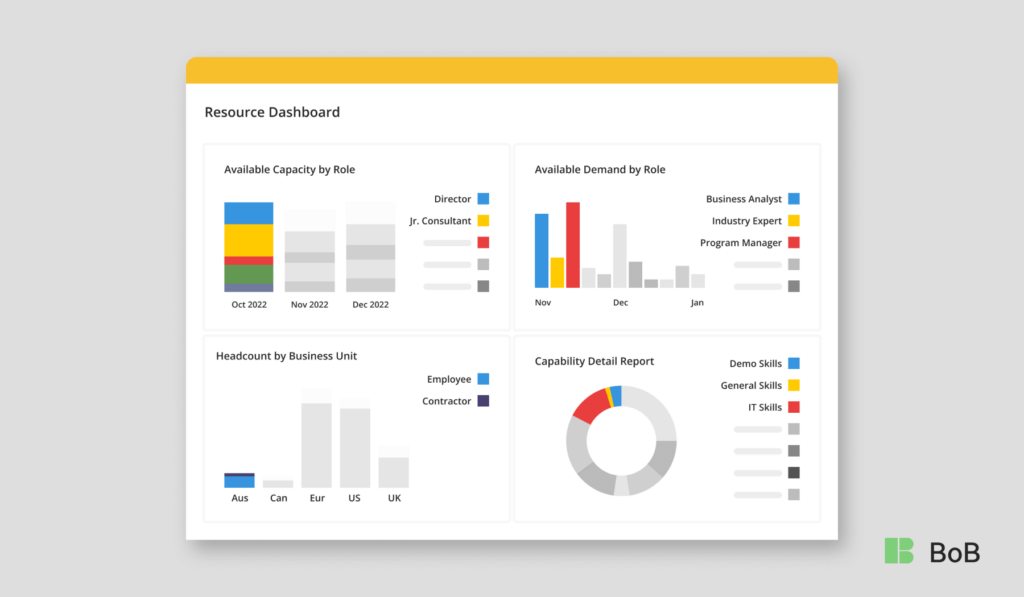
Byoxon (BoB) is opinionated by design. It focuses on operational continuity and visibility without turning configuration into a consulting program.
- Faster setup: designed to get teams working in a consistent workflow quickly.
- Fewer moving parts: less dependency on stitching together multiple systems to get an “operating view.”
- Built for distributed and nearshore teams: visibility across people, projects, and money stays connected.
- Flexible without becoming a consulting project: enough structure to control margins, without forcing an enterprise rollout pattern.
The practical difference is that Byoxon treats service work as a single chain: CRM activity flows into delivery, delivery flows into billing, and billing flows into profitability reporting. In that model, time and expenses are not “captured for later,” they are used to explain what’s profitable, what’s drifting, and why.
| Feature / capability | Byoxon (BoB) | Kantata (Mavenlink) |
|---|---|---|
| Primary focus | Modern service ops across CRM → delivery → billing → profitability | Enterprise PSA across delivery, resourcing, and financial reporting |
| Best fit | Growing service teams that want operational control with fewer tools | Mid-size to enterprise PSO environments needing deep PSA governance |
| PSA depth | Practical ops coverage focused on margins and execution | Deep PSA scope: PM + resourcing + time + billing + reporting |
| CRM continuity | CRM integrated into the operating workflow | Often relies on enterprise CRM connectivity and PSA processes rather than CRM-first ops (varies by setup) |
| Reporting | Profitability-centric reporting (P&L, margin visibility) | Enterprise-grade reporting emphasis and dashboards |
| Implementation motion | Designed to avoid “implementation as a project” | Formal onboarding services and tailored configuration approach |
| Workflow flexibility | Lightweight operational structure, fewer moving parts | Can feel heavier, with a steeper learning curve for some teams |
| Pricing motion | Typically positioned as simpler adoption | Quote-based tailored pricing model |
Use case: enterprise PSO running on Kantata
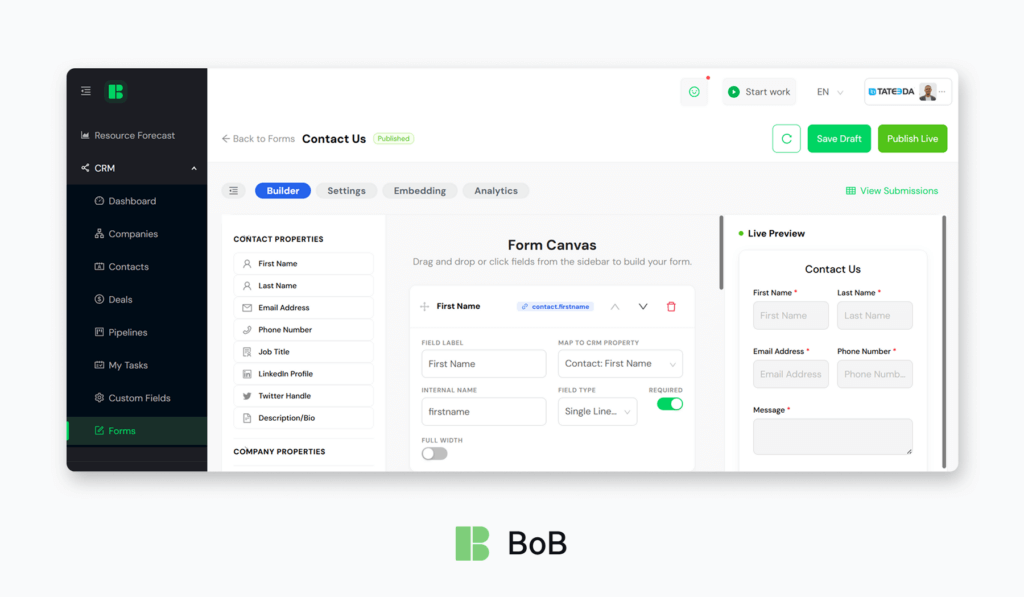
A 250-person professional services organization sells multi-quarter programs with complex staffing requirements. Utilization targets are managed at the portfolio level, forecasting is updated monthly, and leadership expects standardized reporting across regions, practices, and delivery models. The team can justify a formal rollout because the system becomes part of governance: resource managers plan capacity, PMs run delivery inside defined processes, and finance relies on consistent reporting outputs.
In this environment, Kantata’s enterprise PSA posture is a feature, not a burden. The organization accepts longer onboarding and internal admin ownership because standardization is the point. When teams search “professional services automation” at scale, this is the kind of operating model those platforms are built to support.
Use case: mid-sized distributed agency choosing BoB
A 20–40 person agency runs a handful of high-value clients, mixes retainers with fixed-scope work, and uses subcontractors for peaks. The team is distributed internationally, so delivery reality changes quickly: a scope shift on one account can affect staffing on two others. Leadership needs fast answers: which accounts are profitable, which roles are over-serving, and what should be invoiced next.
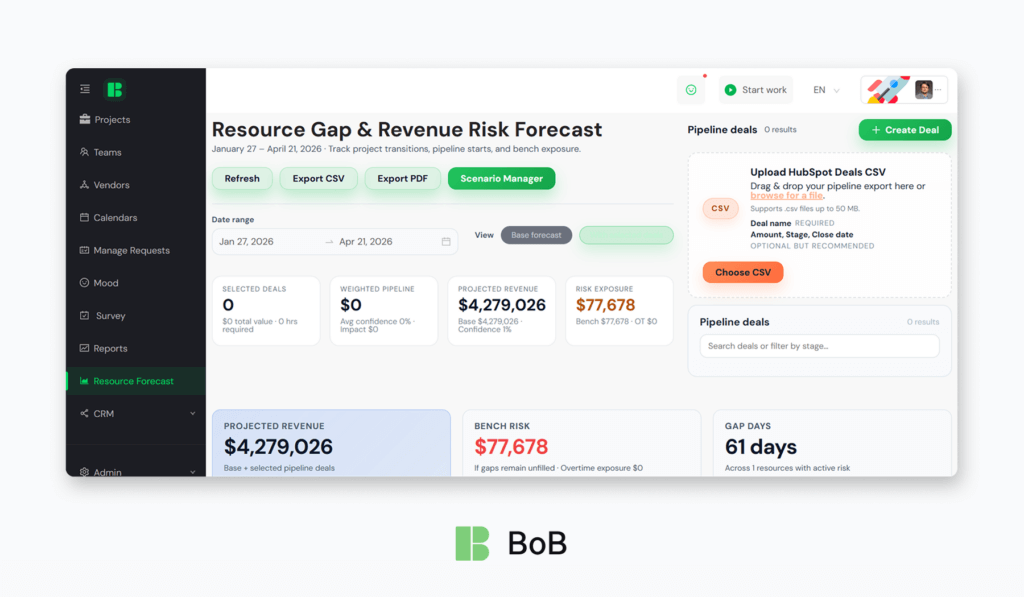
Here, the operational win comes from continuity. CRM records connect to delivery, time, and expenses connect to billing, and reporting shows margin movement without waiting for exports. This is where teams frequently look for a Kantata alternative: not because they want fewer capabilities, but because they want fewer moving parts and less implementation gravity while still maintaining control.
Which fits you better
Choose Kantata if you run a large enterprise PSO where PSA is part of governance, and you can support an implementation and adoption motion that matches enterprise platforms.
Choose Byoxon if you want operational control without enterprise complexity, especially if you need CRM-to-billing continuity and margin visibility without turning rollout into a consulting program.







![Byoxon vs Kantata: Enterprise PSA vs Modern Service Ops [Kantata Alternative Review]](https://byoxon.com/wp-content/uploads/2026/02/BoB-2-4-768x448.png)