Product Comparison
Byoxon vs Toggl Track: One Connected System vs a Best-in-Class Timer
This article compares Byoxon (BoB) and Toggl Track side by side, explaining the difference between a platform that runs the whole commercial workflow and a tool built around an excellent timer. It covers current pricing for both, including Toggl Track’s first-year Premium rate, and shows where the scope gap actually sits — which is not where most comparison pages claim it is.
Toggl Track has one of the best reputations in time tracking, and it earned it. The timer starts in one click, the reports are clean, and teams adopt it without training. Millions of people use it because it removes friction from a task everyone dislikes.
Byoxon starts from a different question. Its product, BeOnBoard (BoB), treats tracked time as one input into a live profit-and-loss statement, alongside a CRM pipeline, invoicing and people management. Time is a means, not the product.
One correction before the comparison starts, because it matters for an honest read. Toggl Track is no longer a bare timer. It reports profitability, sets labor costs, generates invoices and manages time off. If a comparison page tells you it cannot do those things, that page is out of date. The real difference is narrower and more specific, and this article gets to it directly.
Byoxon vs Toggl Track at a glance
| Capability | BoB (Byoxon) | Toggl Track |
|---|---|---|
| Entry paid price | $24.95/user/month (1–10 users) | $9/user/month (Starter, billed annually) |
| Profitability tier price | Included at every paid tier | $14/user/month first year, then $18 (Premium, billed annually) |
| Free plan | Up to 5 users, no feature limitations | Yes, user-capped; PDF invoices carry the Toggl logo |
| Time tracking | Manual entry and automated timers | Manual entry, live timers, autotracker, idle detection |
| Billable and cost rates | Yes | Billable rates from Starter; labor costs from Premium |
| Profitability reporting | Real-time P&L, included at every paid tier | Profitability report on Premium and Enterprise |
| Invoicing | Built in, invoices stored in the platform | Generated as a PDF from a report; not stored in the app |
| Payment collection | Included | Not included; QuickBooks integration from Starter |
| CRM / deal pipeline | Built-in CRM with pipeline stages and deal tracking | No native CRM; integrates with Salesforce, HubSpot and others |
| HR, PTO, recruitment | Employee profiles, PTO, recruitment, vendor management | Time Off management, enabled on request; no recruitment |
| Best fit | Teams running pipeline, delivery and margin in one system | Teams whose central need is accurate, frictionless time data |
Pricing above comes from each vendor’s own pricing page as of August 2026. Toggl Track’s own page states a user limit on the Free plan without naming the number; third-party reviews report five. Verify current numbers before you buy.
Where Toggl Track is the better choice
Take this seriously before reading the rest. Toggl Track wins on real dimensions, and several of them will decide the question for some teams.
- Adoption is close to effortless. Toggl Track’s timer, browser extension, desktop apps and autotracker are best in class. If your problem is that people forget to log hours, Toggl Track solves it better than most platforms do.
- It costs far less per seat. A ten-person team on Toggl Track Starter pays roughly $90 per month on annual billing. The same team on Byoxon pays $249.50. That gap is large and it is real.
- It fits an existing stack. If you already run Salesforce or HubSpot for pipeline and Xero or QuickBooks for finance, you do not need another CRM. You need clean time data feeding what you own, and that is exactly what Toggl Track sells.
- The integration surface is wider. Toggl Track lists more than 100 integrations through its browser extension, plus native Jira and Salesforce connections on Premium.
- The free plan is genuinely usable. Unlimited projects and clients on a free tier is a real offer, not a demo.
The gap is the pipeline, not the timer

A services business runs one continuous chain: a lead arrives, a deal closes at a price, a project gets staffed, hours accumulate, an invoice goes out, and a margin either appears or does not. Every tool you buy covers some segment of that chain.
Toggl Track covers the chain strongly from project set-up onward. It does not cover the front of it. There is no native CRM, no deal pipeline and no quote-to-project handoff. Toggl Track’s own answer is integration, and it is a reasonable answer — Salesforce, HubSpot and Pipedrive all connect.
Byoxon covers the whole chain in one database. That is the difference the angle rests on, and it is worth being precise about what it buys you and what it costs you.
What one system changes in practice
The practical effect is that the price you quoted and the cost you incurred live in the same record. When a deal closes in Byoxon at an agreed rate, the project inherits that rate. Hours logged against it hit a P&L that already knows what you promised. No export, no join key, no reconciliation step.
With a two-tool setup, that link is something you maintain. Client names must match across systems. Rate changes must be updated twice. Someone has to notice when a scope change in the CRM never reached the tracker. None of that is hard; it is simply work that recurs forever and that nobody owns after the person who set it up leaves.
The cost of one system is the obvious one. You are replacing a CRM you may already like, and you are paying more per seat. If your CRM is embedded in how sales works, that is a serious objection and you should weigh it honestly.
See the whole chain in one place
Start free with up to 5 users — no feature limits. Move one live deal from pipeline to invoice inside BeOnBoard and see how much reconciliation disappears. Prefer a walkthrough first? Request a demo and we will show you the P&L view on your kind of project.
Pricing: two curves that move in opposite directions
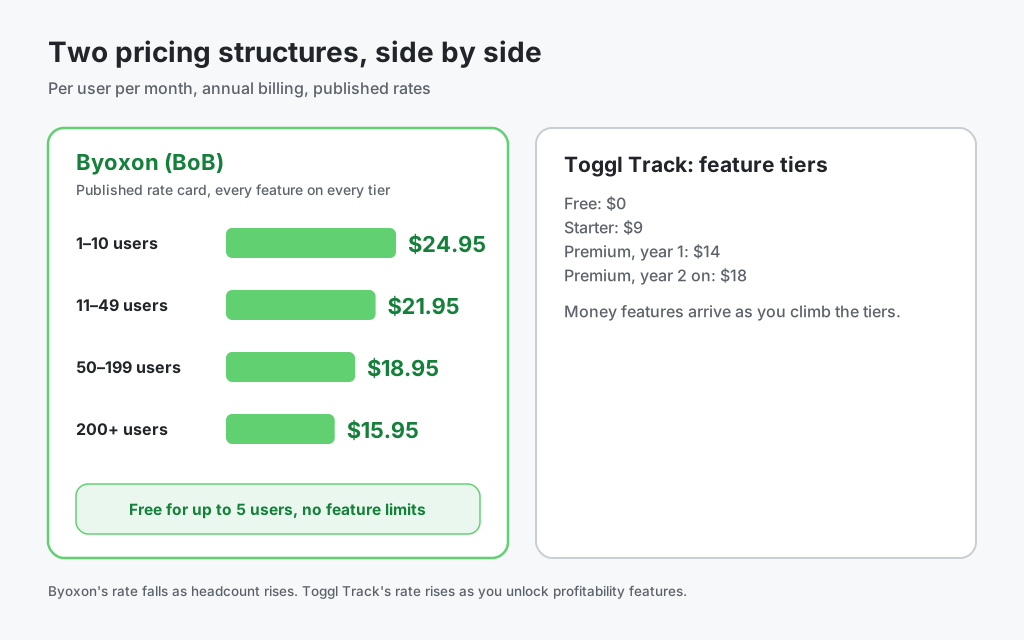
Both vendors publish per-user pricing, so the headline numbers look comparable. The structures underneath them are not.
Byoxon prices by volume. The more seats you add, the less each one costs, and the feature set does not change between bands.
| Team size | Price per user / month |
|---|---|
| 1–10 users | $24.95 |
| 11–49 users | $21.95 |
| 50–199 users | $18.95 |
| 200+ users | $15.95 |
| Free plan | $0 for up to 5 users, no feature limitations |
Toggl Track prices by feature tier. The seat count does not change the rate below Enterprise; the capabilities you need do.
| Plan | Annual billing | What it unlocks |
|---|---|---|
| Free | $0, user-capped | Time tracking, basic reports, calendar and 100+ integrations |
| Starter | $9/user/month | Billable rates, tasks, project estimates and alerts, QuickBooks |
| Premium | $14/user/month first year, then $18 | Profitability analysis, labor costs, fixed-fee projects, approvals, SSO, Jira and Salesforce |
| Enterprise | Custom | Multiple workspaces, volume discounts, dedicated success manager |
Two consequences follow. First, the tier you actually need is Premium, not Starter, if margin reporting is the point of the purchase — so compare $14 to $18 against Byoxon, not $9. Second, Toggl Track’s published Premium annual rate is a first-year rate. Model year two at $18 before you sign, because that is what renewal costs.
Even at $18, Toggl Track is materially cheaper per seat than Byoxon below 50 users. The honest comparison is not seat against seat. It is Toggl Track Premium plus your CRM plus your billing tool against one Byoxon subscription. Run that arithmetic with your real vendor list, because it is the only version of the question that decides anything.
Profitability: where the margin number lives

Toggl Track’s profitability report is a real feature and a good one. It combines billable rates with labor costs to show time, revenue, billable percentage, labor cost, profit and profitability, broken down by member, project, client, task or tag. Labor costs can be set per workspace or per project, and the more specific rate wins.
Two constraints come with it. It sits on Premium and above, and it is scoped to what Toggl Track knows — tracked time, rates and costs. Fixed-fee revenue recognition, non-labor project costs and subcontractor spend live in whatever system you use for finance, so a complete picture still requires assembly.
Byoxon computes P&L continuously against the commercial terms already stored on the deal, and includes it at every paid tier. The difference is less about which report is richer and more about when the number is trustworthy without a spreadsheet in front of it.
Invoicing: the detail most comparisons miss
Toggl Track does generate invoices. You filter a Summary or Detailed report, choose Export, then Create Invoice, edit the billing details and download a PDF. It works well for straightforward time-based billing.
The constraint is documented in Toggl Track’s own knowledge base: generated invoices are not saved within the app. There is no stored invoice history, no aging view and no payment collection. The intended path for a real billing workflow is the QuickBooks integration, available from Starter.
Byoxon stores invoices as records inside the platform and connects them back to the project and the deal, which is what makes receivables visible next to margin. If your accounting system already owns invoicing end to end, this difference costs you nothing. If it does not, it is the gap you will feel first.
Which one fits your team
Choose Toggl Track when:
- Accurate, low-friction time capture is the problem you are solving
- Your CRM and accounting stack is already chosen and working
- Per-seat cost is a hard constraint
- You are comfortable maintaining integrations between systems
Choose Byoxon when:
- You want pipeline, delivery, billing and margin in one record
- Reconciling tools before a management meeting is a recurring cost
- Profitability needs to be visible during delivery, not after invoicing
- You are consolidating subscriptions rather than adding one
If you are still mapping the market, our Byoxon vs Harvest and Byoxon vs Clockify comparisons cover neighbouring tools on the same spectrum. You can also model your own numbers with the free time tracking calculator or read how Byoxon handles project cost management.
Frequently asked questions
Does Toggl Track have a built-in CRM?
No. Toggl Track has no native CRM or deal pipeline. It connects to external CRMs instead, including a native Salesforce integration on its Premium plan and third-party connections to HubSpot and Pipedrive. Byoxon includes a CRM with pipeline stages and deal tracking in the same system as time and billing.
Can Toggl Track show project profitability?
Yes, on the Premium and Enterprise plans. Toggl Track’s profitability report uses billable rates and labor costs to show revenue, labor cost, profit and profitability by member, project, client, task or tag. Byoxon differs by computing P&L in real time against the deal terms and including it at every paid tier.
Does Toggl Track do invoicing?
Partly. You can create an invoice from a Summary or Detailed report and download it as a PDF. Toggl Track’s knowledge base states that generated invoices are not saved within the app, and there is no built-in payment collection. Teams that need stored invoice history typically use the QuickBooks integration.
Why does Byoxon cost more per user than Toggl Track?
Byoxon’s per-user price covers CRM, time tracking, invoicing, HR and project analytics in one subscription, so the fair comparison is against your combined tool spend rather than against a time tracker alone. Note also that Toggl Track’s $14 Premium annual rate applies to the first year and renews at $18.
Can I try Byoxon before paying?
Yes. Byoxon offers a free plan for up to five users with no feature limitations, so you can run a real project through CRM, time tracking and P&L reporting before committing.
The bottom line
Toggl Track is an excellent time tracker that has grown a credible financial layer around itself. If time data is your bottleneck and your CRM and accounting are settled, it is the cheaper and lighter answer, and it will be adopted faster.
Byoxon answers a different question: what did we promise, what is it costing us, and are we still ahead — asked continuously, across pipeline, delivery and billing, from one record. That scope is what the higher seat price buys.
Count the systems you reconcile before a management meeting. If the answer is one, keep the timer. If it is three, the consolidation is worth pricing.
Start free with up to 5 users — no feature limits. Move one live deal from pipeline to invoice inside Byoxon and see how much reconciliation disappears.